75. Andrea Cerrato; Aldo Laganà; Carmela Maria Montone; Enrico Taglioni; Daniel Weissman; Anna Laura Capriotti. Aza-Paternò–Büchi derivatization enables annotation of triacylglycerols by negative-ion-mode mass spectrometry at the double bond level. Talanta 2027, 312(Pt A), 130396. Published online 7 August 2026. https://doi.org/10.1016/j.talanta.2026.130396
74. Xi Chen; Gopal Reddy Ramidi; Nitya Shree; Dallas Freitas; Syuan-Ting Kuo; Huiying Guo; Luchen Wuyang; Aidan Slagter; Peiyu Cai; Ashok Polu; Mahua Choudhury; Xin Yan. Duplex Paternò–Büchi Isobaric Reagents for One-Step C═C-Resolved Lipid Isomer Quantification. Journal of the American Chemical Society 2026, 148(39), 42508–42520. https://doi.org/10.1021/jacs.6c13813
73. Ruoling Yang; Man Song; Qingyang Liu; Jingwen Tang; Yujun Wei; Dongxue Ge; Kun Qian; Yangliu Shao; Haoyang Zhang; Hanlin Xue; Yikun Liu; Liping Dou; Daihong Liu. Structural lipidomics identifies murine plasma C=C location isomers for radiation dose stratification. Cell Biology and Toxicology 2026. Published online 28 August 2026. https://doi.org/10.1007/s10565-026-10257-1
72. Yiwei Tou; Wei Sun; Pai Liu; Jiuyi Sun; Taiyang Ma; Yun-Hong Zhang. Structural Lipidomics Uncovers C═C Location-Specific Lipid Signatures and the Response to Immune Checkpoint Inhibitor in dMMR/MSI-H Colorectal Cancer. ACS Measurement Science Au 2026, 6(3), 655–667. https://doi.org/10.1021/acsmeasuresciau.5c00200
71. Andrea Cerrato; Enrico Taglioni; Chiara Cavaliere; Aldo Laganà; Elena Lucà; Carmela Maria Montone; Anna Laura Capriotti. Azetidination-based photocycloaddition enables regioisomer-resolved annotation of cholesteryl esters by negative-ion-mode LC-MS/MS. Analytica Chimica Acta 2026, 1402, 345392. https://doi.org/10.1016/j.aca.2026.345392
70. Wanying Hu; Wenhan Li; Meirong Song; Jianfei Zhu; Kui Zhu. Rule-Based Ion Prediction with Orthogonal Constraints Reveals Bacterial Phospholipid Remodeling Signatures. Antibiotics 2026, 15(5), 459. https://doi.org/10.3390/antibiotics15050459
69. Zhijun Cai; Ningxi Li; Simin Cheng; Zheng Ouyang; Xiaoxiao Ma. Single-cell structural lipidomics using a miniature dual-LIT mass spectrometer. Chemical Science 2026, 17(7), 3828–3840. https://doi.org/10.1039/D5SC08665E
68. Manal Alhusban; Suha Telfah; Mohammad M. Al-Gharaibeh; Sanaa Bardaweel; Raghad Alkadri; Fang Wei. Comprehensive Profiling of Triglycerides in Wild Eastern Mediterranean Echium Seed Oil Using Paternò–Büchi Modulated Lipidomics. Molecules 2026, 31(3), 550. https://doi.org/10.3390/molecules31030550
67. Zhuoning Xie; Qirui Yu; Simin Cheng; Dan Li; Zheng Ouyang; Xiaoxiao Ma. ¹³C-Isotope Tracing Structural Lipidomics for Resolving Phospholipid Metabolism Dynamics in Human Breast Cancer Cells. Analytical Chemistry 2026, 98(3), 2401–2413. https://doi.org/10.1021/acs.analchem.5c06789
66. Yang Gu; Ming-Ming Shao; Song-Ping Cui; Bin Hu; Xin Li. Deep structural lipidomic profiling reveals C=C positional isomers as potential biomarkers in lung adenocarcinoma tissue. Translational Lung Cancer Research 2025, 14(11), 4768–4783. https://doi.org/10.21037/tlcr-2025-717
65. Hao Xu; Tianhang Jiang; Yuxiang Lin; Lei Zhang; Huan Yang; Xiaoyun Huang; Ridong Mao; Zhu Yang; Changchun Zeng; Shuang Zhao; Lijun Di; Wenbin Zhang; Jun Zeng; Zongwei Cai; Shu-Hai Lin. LipidIN: a comprehensive repository for flash platform-independent annotation and reverse lipidomics. Nature Communications 2025, 16, 4566. https://doi.org/10.1038/s41467-025-59683-5
64. Wenjiao Wang; Zhiqian Liu; Simone Rochfort. Can fragment ion intensity be used for fatty acid sn-position determination of food phospholipids? Journal of Food Composition and Analysis 2025, 137, 106923. https://doi.org/10.1016/j.jfca.2024.106923
63.Qi L, Li X, Ren Y, et al. A Facile Workflow for Sebum Fatty Acids and Squalene Identification via Advanced Lipidomic Methodologies. Anal Chem. 2025;97(18):9664-9674. doi:10.1021/acs.analchem.4c06010
62.Hu D, Lui TY, Chen X, Chan TD. A Mass Spectrometric Study of the Role of Water in the Paternò-Büchi (PB) Reaction between 2-Acetylpyridine and Unsaturated Fatty Acids. J Am Soc Mass Spectrom. 2025;36(6):1366-1376. doi:10.1021/jasms.5c00075
61.Ruiquan Ding, Yingzhuang C*,et al. Paternò-Büchi Reaction-Mediated High-Selectivity Screening of Isoprene-Containing Naturals by LC-HRMS Talanta,2025
60.Alice T, Grazia B*. et al.Characterization of double bond position in free fatty acids of human sebum. Journal of Chromatography Open 2025
59.Qing-xuan Ren, Wen Gap, et al. Molecular networking and Paterno-Büchi reaction guided glycerides characterization and antioxidant activity assessment of Ganoderma lucidum spore oil. Food Chemistry, 2025.
58.Xiangyu Gao, Xue Zhao, et al. Isomer-Resolved Characterization of Acylcarnitines Reveals Alterations in Type 2 Diabetes. Analytica Chimica Acta, 2025.
57.Rongrong Fu, Suming Chen, et al. Tracking the Geometric and Positional Isomerization of Lipid C═C Bonds in the Bacterial Stress Responses by Mass Spectrometry. Analytical Chemistry, 2025.
56. Montone CM, Cavaliere C, Cerrato A, et al. Detailed lipid investigation of edible seaweeds by photochemical derivatization and untargeted lipidomics. Anal Bioanal Chem. 2024;416(28):6269-6282.
doi:10.1007/s00216-024-05573-6
55. Gosset-Erard C, Han G, Kyrko D, et al. Structural characterization of N-acyl-homoserine lactones from bacterial quorum sensing using LC-MS/MS analyses after Paternò-Büchi derivatization in solution. Anal Bioanal Chem. 2024;416(25):5431-5443.
doi:10.1007/s00216-024-05355-0
54. Cheng S, Cao C, Qian Y, et al. High-throughput single-cell mass spectrometry enables metabolic network analysis by resolving phospholipid C[double bond, length as m-dash]C isomers. Chem Sci. 2024;15(17):6314-6320.
doi:10.1039/d3sc06573a
53. Wang Z.; Garza S.; Li X.; Rahman M. S.; Brenna J. T.*; Wang D. H.^; Paternò–Büchi Reaction Mass Spectrometry Enables Positional Assignment of Polymethylene-Interrupted Double Bonds in Food-Derived Lipids. J. Agric. Food Chem. 2024.
https://doi.org/10.1021/acs.jafc.3c06366
52. Chen M.; Wang R.; Ren Q. X.; Li B.; Li P.*; Yang H.*; Gao W.*; Analysis of unsaturated fatty acids by supercritical fluid chromatography tandem mass spectrometry coupled with online Paternò-Büchi reaction. Microchemical Journal. 2023, 109551.
https://doi.org/10.1016/j.microc.2023.109551
51. Guo X. Y.; Cao W. B.; Fan X. M.; Guo Z. Y.; Zhang D. H.; Zhang H. Y.; Ma X. X.; Dong J. H.; Wang Y. F. *; Zhang W. P. *; Ouyang Z.*; Tandem Mass Spectrometry Imaging Enables High Definition for Mapping Lipids in Tissues. Angew Chem Int Ed Engl. 2023, 62, 9, e202214804
https://doi.org/10.1002/anie.202214804
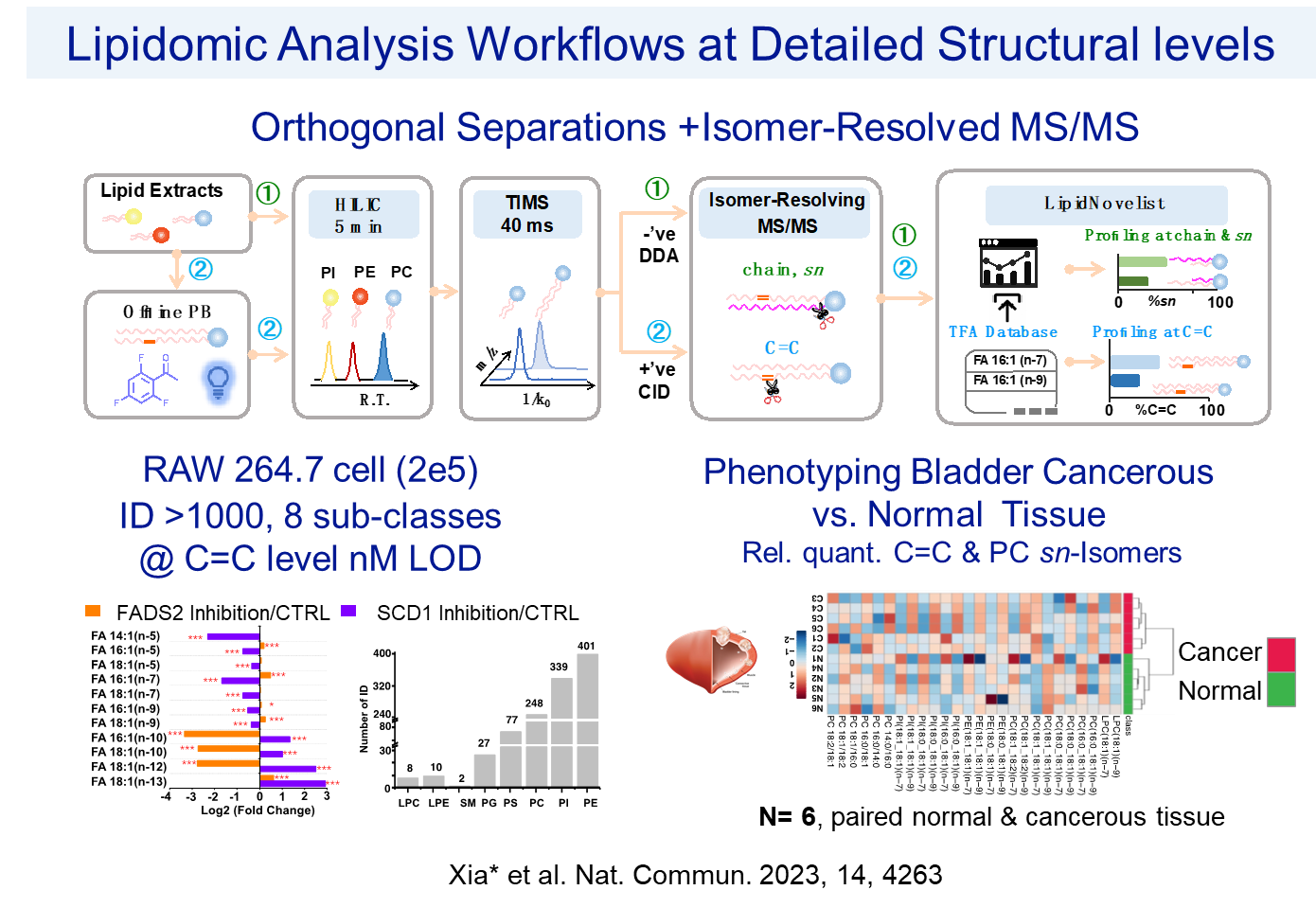
50. Cheng S. M.; Xie Z. N.; Hu Q. Y.; Qian Y.; Ma X. X.*; Familiarizing Undergraduate Students with Advanced Mass Spectrometry Techniques: An Example of Detailed Lipid Structure Characterization. J. Chem. Educ. 2023, 100, 3, 1270–1276.
https://doi.org/10.1021/acs.jchemed.2c00824
49. Cheng S. M.; Zhang D. H.; Feng J. X.; Hu Q. Y.; Tan A.; Xie Z. N.; Chen Q. H.; Huang H. M.; Wei Y.; Ouyang Z.*; Ma X. X.*; Metabolic Pathway of Monounsaturated Lipids Revealed by In-Depth Structural Lipidomics by Mass Spectrometry. Research, 2023, 6, 0087.
https://doi.org/10.34133/research.0087
48. Hu W. Y.; Han Y. H.*; Selective Characterization of Olefins by Paternò–Büchi Reaction with Ultrahigh Resolution Mass Spectrometry. Anal. Chem. 2023.
https://doi.org/10.1021/acs.analchem.3c02966
47. Freitas D. P.; Yan X.*; In situ droplet-based on-tissue chemical derivatization for lipid isomer characterization using LESA. Analytical and Bioanalytical Chemistry 2023, 415, 4197–4208.
https://doi.org/10.1007/s00216-023-04653-3
46. Lu H. Y.; Zhang H.; Li L. J.*; Chemical tagging mass spectrometry: an approach for single‑cell Omics. Analytical and Bioanalytical Chemistry. 2023.
https://doi.org/10.1007/s00216-023-04850-0
45. Kanter J. P.; Honold P. J.; Luh D.; Heiles S., Spengler B.; Fraatz M. A.; Zorn H.; Hammer A. K.*; Biocatalytic Production of Odor-Active Fatty Aldehydes from Fungal Lipids. J. Agric. Food Chem. 2023, 71, 21, 8112–8120
https://doi.org/10.1021/acs.jafc.3c01972
44. Wang D. H.; Brenna J. T.*, and Shchepinov M. S.*; Quantitative High-Field NMR- and Mass Spectrometry-Based Fatty Acid Sequencing Reveals Internal Structure in Ru-Catalyzed Deuteration of Docosahexaenoic Acid. Anal. Chem. 2022, 94, 38, 12971–12980.
https://doi.org/10.1021/acs.analchem.2c00923
43. Kanter J.P.; Honold P. J.; Lüke D.; Heiles S.; Spengler B.; Fraatz M. A.; Harms C.; Ley J. P.; Zorn H.; Hammer A. K.*; An enzymatic tandem reaction to produce odor-active fatty aldehydes. Appl. Microbiol. Biotechnol. 2022, 106, 6095–6107
https://doi.org/10.1007/s00253-022-12134-3
42. Bednařík A.*; Prysiazhnyi V.; Bezdeková D.; Soltwisch J.; Dreisewerd K.; Preisler J.*; Mass Spectrometry Imaging Techniques Enabling Visualization of Lipid Isomers in Biological Tissues. Anal. Chem. 2022, 94, 12, 4889–4900.
https://doi.org/10.1021/acs.analchem.1c05108
41. Bechtella L.; Walrant A.*; Structural Bases for the Involvement of Phosphatidylinositol-4,5-bisphosphate in the Internalization of the Cell-Penetrating Peptide Penetratin. ACS Chem. Biol. 2022, 17, 6, 1427–1439.
https://doi.org/10.1021/acschembio.1c00974
40. Cerrato A.; Capriotti A. L.*; Novel Aza-Paternò-Büchi Reaction Allows Pinpointing Carbon–Carbon Double Bonds in Unsaturated Lipids by Higher Collisional Dissociation. Anal. Chem. 2022, 94, 38, 13117–13125.
https://doi.org/10.1021/acs.analchem.3c02966
39. Christiana M.;Kokotou M. G.*; Liquid Chromatography-Mass Spectrometry (LC-MS) Derivatization-Based Methods for the Determination of Fatty Acids in Biological Samples. Molecules 2022, 27(17), 5717
https://doi.org/10.3390/molecules27175717
38. Sun C. L.*; Wan X.*; A novel on-tissue cycloaddition reagent for mass spectrometry imaging of lipid C=C position isomers in biological tissues. Chinese Chemical Letters 2022, 33, 2073-2076.
https://doi.org/10.1016/j.cclet.2021.08.034
37. Hynds H. M.;Hines K. M.*; Ion Mobility Shift Reagents for Lipid Double Bonds Based on Paternò–Büchi Photoderivatization with Halogenated Acetophenones. J. Am. Soc. Mass Spectrom. 2022, 33, 10, 1982–1989
https://doi.org/10.1021/jasms.2c00211
36. Chen Y. Y.; Xie C. Y.; Wang X. X.; Cao G. D.; Ru. Y.; Song Y. Y.; Iyaswamy A.; Li M.; Wang J. N.*; Cai Z. W.*; 3‑Acetylpyridine On-Tissue Paterno−Buchi Derivatization Enabling High Coverage Lipid C=C Location-Resolved MS Imaging in Biological Tissues. Analytical Chemistry, 2022.
https://doi.org/10.1021/acs.analchem.2c03089
35. Feng, G. F.; Gao, M.; Wang L.W.; Chen J. Y.; Hou M. L.; Wan Q. Q.; Lin Y.; Xu G. Y.; Qi X. T.; Chen S. M.*; Dual-resolving of positional and geometric isomers of C=C bonds via bifunctional photocycloaddition-photoisomerization reaction system. Nature Communications, 2022, 13, 2652
https://doi.org/10.1038/s41467-022-30249-z
34. Mao, R.; Li, W.; Ji, P.; Ding, H.; Teka, T.; Zhang, L.; Fu, Z.; Fu, X.; Kaushal, S.; Dou, Z.*; Han, L.*; An efficient and sensitive method on the identification of unsaturated fatty acids in biosamples: Total lipid extract from bovine liver as a case study. Journal of Chromatography A, 2022, 1675, 463176
https://doi.org/10.1016/j.chroma.2022.463176
33. Sun, J.; Liu, R. X.; Li, S.; Li, W. *; M. L. Gross*; Nanoparticles and photochemistry for native-like transmembrane protein footprinting. Nature Communications, 2021, 12, 7270
https://doi.org/10.1038/s41467-021-27588-8
32. Han, Y.; Chen, P.; Li, Z.; Wang, X.; Sun, C. *; Multi-wavelength visible-light induced [2+2] cycloaddition for identification of lipid isomers in biological samples. Journal of Chromatography A, 2022, 1662, 462742
https://doi.org/10.1016/j.chroma.2021.462742
31. Liu, Z.; S. Rochfort*; Regio-distribution and double bond locations of unsaturated fatty acids in phospholipids of bovine milk. Food Chemistry, 2021, Available online 2 November.
https://doi.org/10.1016/j.foodchem.2021.131515
30. Deng, J.; Yang, Y.*; Zeng, Z.; Xiao, X.; Li, J.; Luan, T.*; Discovery of Potential Lipid Biomarkers for Human Colorectal Cancer by In-Capillary Extraction Nanoelectrospray Ionization Mass Spectrometry. Analytical Chemistry, 2021, 93, 38, 13089–13098
https://doi.org/10.1021/acs.analchem.1c03249
29. Zhang, J.; Guo, C.; Huo, X.; Ma, X.; Li, X.; Zeper, A.; Chu, Y.; Wang, X.; Tang, F.; Unsaturated lipid isomeric imaging based on the Paternò–Büchi reaction in the solid phase in ambient conditions. Talanta, 2021, 235, 122816.
https://doi.org/10.1016/j.talanta.2021.122816
28. Sun, C; Ma, C; Li, L; Han, Y; Wang, D; Wan,X; "A novel on-tissue cycloaddition reagent for mass spectrometry imaging of lipid C=C position isomers in biological tissues", Chinese Chemical Letters, 2021, Available online 12 August.
https://doi.org/10.1016/j.cclet.2021.08.034
27. Huang, W.; Zhou. H.; Yuan, M.; Lan, L.; Hou, A.; Ji, S. Comprehensive Characterization of the Chemical Constituents in Platycodon Grandiflorum by an Integrated Liquid Chromatography-Mass Spectrometry Strategy. Journal of Chromatography A, 2021, 1654, 462-477.
https://doi.org/10.1016/j.chroma.2021.462477
26. Yang Y. Coupling Paternò-Büchi Reaction with Ambient NanoESI-MS for Identification of Unsaturated Triacylglycerols in Peanut Oils. Journal of Chinese Mass Spectrometry Society, 2021, 42(4): 455-461.
http://www.jcmss.com.cn/EN/10.7538/zpxb.2021.0032
25. Wang, D.; Park, H.; Wang, Z.; Lacombe, R.S.; Shmanai, V.V.; Bekish, A.V.; Schmidt, K.; Shchepinov, M.S.; Brenna, J.T.“Toward Quantitative Sequencing of Deuteration of Unsaturated Hydrocarbon Chains in Fatty Acids" Analytical Chemistry, 2021, 93, 8238–8247
https://doi.org/10.1021/acs.analchem.1c01016
24. Xu, S.; Lv, X.; Wu, B.; Xie, Y.; Wu, Z.; Tu, X.; Chen, H.; Wei, F. Pseudotargeted Lipidomics Strategy Enabling Comprehensive Profiling and Precise Lipid Structural Elucidation of Polyunsaturated Lipid-Rich Echium Oil. Journal of Agricultural and Food Chemistry, 2021
https://doi.org/10.1021/acs.jafc.0c07268
23. Wäldchen, F.; Mohr, F.; Wagner, A.H.; Heiles, S. "Multifunctional reactive MALDI matrix enabling high-lateral resolution dual polarity MS imaging and lipid C= C position-resolved MS2 imaging." Analytical Chemistry. 2020, 92, 14130–14138
https://doi.org/10.1021/acs.analchem.0c03150
22. Jeck, V.; Froning, M.; Tiso, T.; Blank, L. M.; Hayen, H. "Double bond localization in unsaturated rhamnolipid precursors 3-(3-hydroxyalkanoyloxy) alkanoic acids by liquid chromatography–mass spectrometry applying online Paternò–Büchi reaction." Analytical and bioanalytical chemistry, 2020, 412, 5601-5613.
https://link.springer.com/article/10.1007/s00216-020-02776-5
21.Maddox, S. W., Olsen, S. S., Velosa, D. C., Burkus-Matesevac, A., Peverati, R., & Chouinard, C. D. Improved Identification of Isomeric Steroids using the Paternò-Büchi Reaction with Ion Mobility-Mass Spectrometry. Journal of the American Society for Mass Spectrometry, 2020, 31, 2086–2092
https://doi.org/10.1021/jasms.0c00215
20. Xu, S.; Wei, F.; Xie, Y.; Wu, B.; Lv, X.; Qin, Z.; Chen, H. Localisation of C=C Bond and Absolute Quantification of Unsaturated Fatty Acids in Vegetable Oils based on Photochemical Derivatisation Reaction Coupled with Mass Spectrometry. International Journal of Food Science & Technology, 2020, 55, 2883-2892
https://doi.org/10.1111/ijfs.14546
19. Li, P.; Deng, J.; Xiao, N.; Cai, X.; Wu, Q.; Lu, Z.; Du, B. "Identification of polyunsaturated triacylglycerols and CC location isomers in sacha inchi oil by photochemical reaction mass spectrometry combined with nuclear magnetic resonance spectroscopy." Food chemistry, 2020, 307, 125568.
https://doi.org/10.1016/j.foodchem.2019.125568
18. Zhu, Y.; Wang, W.; Yang, Z. "Combining Mass Spectrometry with Paternò-Büchi Reaction to Determine Double-bond Positions in Lipids at the Single-cell Level." Analytical Chemistry, 2020, 92, 11380–11387
https://doi.org/10.1021/acs.analchem.0c02245
17. Xu, S.; Wu, B.; Oresic, M.; Xie, Y.; Yao, P.; Wu, Z.; Wei, F. "Double Derivatization Strategy for High-Sensitivity and High-Coverage Localization of Double Bonds in Free Fatty Acids by Mass Spectrometry." Analytical Chemistry, 2020, 92, 6446-6455.
https://doi.org/10.1021/acs.analchem.9b05588
16. Feng, G.; Hao, Y.; Wu, L.; Chen, S. "A visible-light activated [2+ 2] cycloaddition reaction enables pinpointing carbon–carbon double bonds in lipids." Chemical Science, 2020, 11, 7244-7251.
https://doi.org/10.1039/D0SC01149E
15. Esch, P.; Heiles, S. "Investigating C=C Positions and Hydroxylation Sites in Lipids Using Paternò–Büchi Functionalization Mass Spectrometry." Analyst, 2020, 145, 2256-2266.
https://doi.org/10.1039/C9AN02260K
14. Wäldchen, F.; Spengler, B.; Heiles, S. "Reactive Matrix-Assisted Laser Desorption/Ionization Mass Spectrometry Imaging Using an Intrinsically Photoreactive Paternò–Büchi Matrix for Double-Bond Localization in Isomeric Phospholipids." Journal of the American Chemical Society, 2019, 141, 11816-11820.
https://doi.org/10.1021/jacs.9b05868
13. Deng, J.; Yang, Y.; Liu, Y.; Fang, L.; Lin, L.; Luan, T. "Coupling Paternò-Büchi Reaction with Surface-Coated Probe Nanoelectrospray Ionization Mass Spectrometry for In Vivo and Microscale Profiling of Lipid C═ C Location Isomers in Complex Biological Tissues." Analytical chemistry, 2019, 91, 4592-4599.
https://doi.org/10.1021/acs.analchem.8b05803
12. Esch, P.; Fischer, M.; Heiles, S.; Schäfer, M. "Olefinic Reagents Tested for Peptide Derivatization with Switchable Properties: Stable upon Collision Induced Dissociation and Cleavable by In-Source Paternò-Büchi Reactions." Journal of Mass Spectrometry, 2019, 54, 976-986.
https://doi.org/10.1002/jms.4474
11. Birk, F.; Fraatz, M. A.; Esch, P.; Heiles, S.; Pelzer, R.; Zorn, H. "Industrial Riboflavin Fermentation Broths Represent a Diverse Source of Natural Saturated and Unsaturated Lactones." Journal of Agricultural and Food Chemistry, 2019, 67, 13460-13469.
https://doi.org/10.1021/acs.jafc.9b01154
10. Zhao, X.; Chen, J.; Zhang, W.; Yang, C.; Ma, X.; Zhang, S.; Zhang, X. "Lipid Alterations during Zebrafish Embryogenesis Revealed by Dynamic Mass Spectrometry Profiling with C=C Specificity." Journal of The American Society for Mass Spectrometry, 2019, 30, 2646-2654.
https://doi.org/10.1021/jasms.8b06287
9. Bednařík, A.; Bölsker, S.; Soltwisch, J.; Dreisewerd, K., "An On-Tissue Paternò–Büchi Reaction for Localization of Carbon–Carbon Double Bonds in Phospholipids and Glycolipids by Matrix-Assisted Laser-Desorption–Ionization Mass-Spectrometry Imaging." Angewandte Chemie International Edition, 2018, 57, 12092-12096.
https://doi.org/10.1002/ange.201806635
8. Jeck, V.; Korf, A.; Vosse, C.; Hayen, H. "Localization of Double-Bond Positions in Lipids by Tandem Mass Spectrometry Succeeding High-Performance Liquid Chromatography with Post-Column Derivatization." Rapid Communications in Mass Spectrometry, 2019, 33, 86-94.
https://doi.org/10.1002/rcm.8262
7. Bechtella, L.; Kirschbaum, C.; Cosset, M.; Clodic, G.; Matheron, L.; Bolbach, G.; Sagan, S.; Walrant, A.; Sachon, E. "Benzophenone Photoreactivity in a Lipid Bilayer To Probe Peptide/Membrane Interactions: Simple System, Complex Information." Analytical Chemistry, 2019, 91, 9102-9110.
https://doi.org/10.1021/acs.analchem.9b01584
6. Korf, A.; Jeck, V.; Schmid, R.; Helmer, P. O.; Hayen, H. "Lipid Species Annotation at Double Bond Position Level with Custom Databases by Extension of the MZmine 2 Open-Source Software Package." Analytical Chemistry, 2019, 91, 5098-5105.
https://doi.org/10.1021/acs.analchem.8b05493
5. Xu, T.; Pi, Z.; Song, F.; Liu, S.; Liu, Z. "Benzophenone used as the photochemical reagent for pinpointing C= C locations in unsaturated lipids through shotgun and liquid chromatography-mass spectrometry approaches." Analytica chimica acta, 2018, 1028, 32-44.
https://doi.org/10.1016/j.aca.2018.04.046
4. Esch, P.; Heiles, S. "Charging and Charge Switching of Unsaturated Lipids and Apolar Compounds Using Paternò-Büchi Reactions." Journal of the American Society for Mass Spectrometry, 2018, 29, 1971-1980.
https://doi.org/10.1021/jasms.8b05694
3. Wäldchen, F.; Becher, S.; Esch, P.; Kompauer, M.; Heiles, S. "Selective Phosphatidylcholine Double Bond Fragmentation and Localisation Using Paternò–Büchi Reactions and Ultraviolet Photodissociation." Analyst, 2017, 142, 4744-4755.
https://doi.org/10.1039/C7AN01158J
2. Murphy, R. C.; Okuno, T.; Johnson, C. A.; Barkley, R. M. "Determination of double bond positions in polyunsaturated fatty acids using the photochemical Paterno-Buchi reaction with acetone and tandem mass spectrometry." Analytical Chemistry, 2017, 89, 8545-8553.
https://doi.org/10.1021/acs.analchem.7b02375
1. Jiang, X.; Wang, J.; Guan, Q.; Hu, J.; Xu, J.; Chen, H. "Identification of C=C Location of Unsaturated Phosphatidylcholines in Cell by Photochemical Reaction-Tandem Mass Spectrometry." Chinese Journal of Analytical Chemistry, 2017, 45, 1988-1995.
https://doi.org/10.11895/j.issn.0253-3820.170350